Preventing Waste
Every April, humans worldwide celebrate the planet that sustains our very existence. Some activities in this observance include community cleaning efforts, planting trees and vegetables, educating others on climate change, learning to compost, or simply spreading the message of going green. All these efforts contribute to saving and protecting Mother Earth, who is currently undergoing critical instability. Climate change does not only affect the weather, our health, and vital ecosystems—it also threatens the global economy. Extreme and unpredictable weather causing infrastructure damage will directly result in reduced labor productivity. If it’s hotter, crops will fail: food security will be no more. There won’t be an economy to stimulate if we’re all struggling to get our hands on the bare necessities. Though the situation feels dire, there are solutions we can either implement or support to guarantee a functional and happy future for us all.
Groups like Circular Philadelphia are pushing what’s called the “circular economy model” to eliminate waste whilst still promoting economic growth. Their website explains this approach: “Instead of the make, take and trash system that defined the industrialism of the 20th century, a circular economy reuses materials as long as possible, shares resources, designs out waste, and regenerates natural systems. It reimagines the old system as a continuous loop that transforms how we design, make and use everything.” Their organization works with building trades, food producers, both fashion designers and retail stores, and even local legislation to develop new ways to minimize waste and properly enact circular principles.
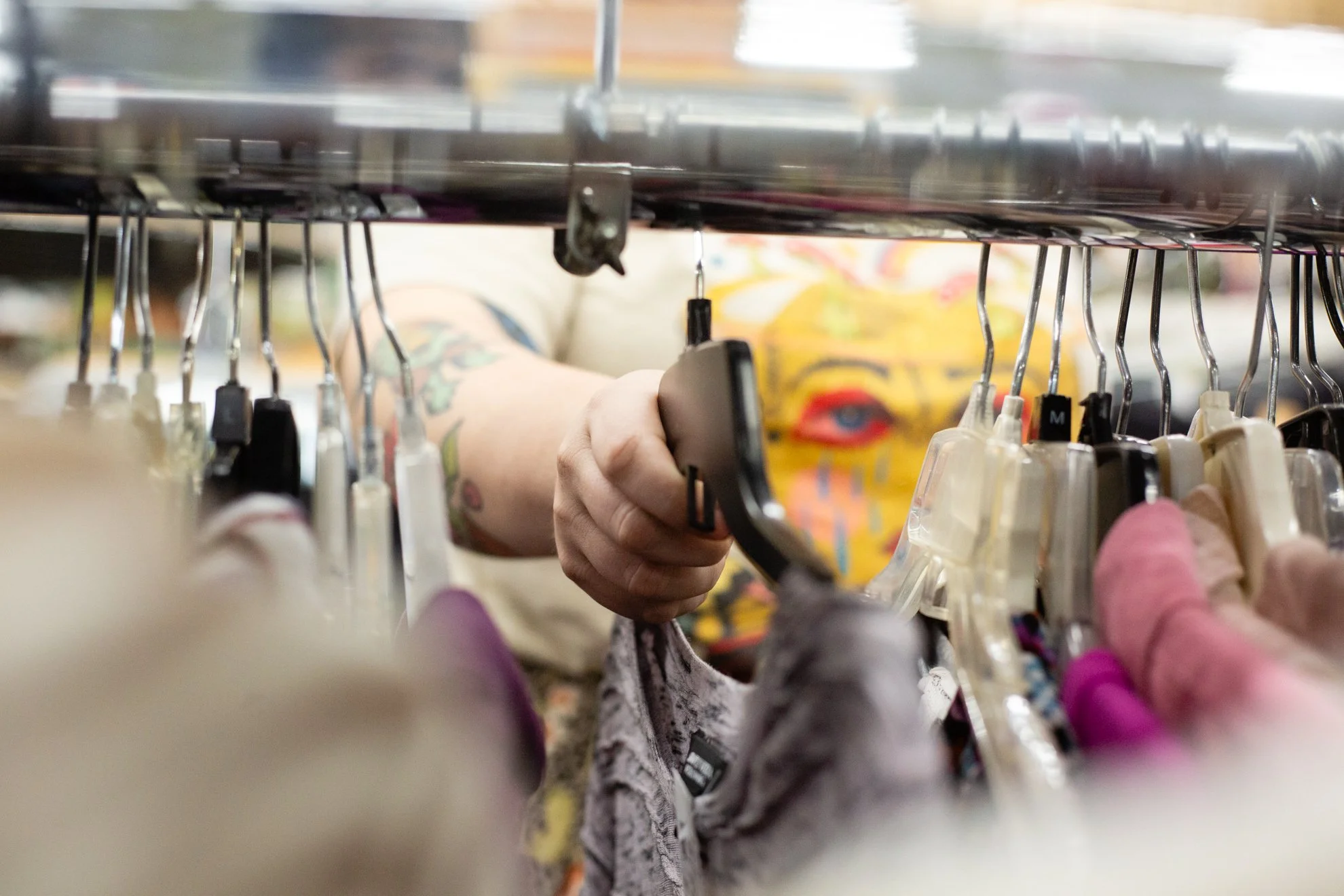
Thrift stores, of course, especially play a significant role in the circular economy strategy. Using materials as long as possible is kind of their thing! Shopping secondhand prevents waste accumulation by keeping perfectly good items out of landfills, combats the need for cheap, disposable items that harm the environment, and is a much more accessible option for individuals who want to begin reducing their carbon footprint, but perhaps don’t know where to start. Some activities like learning to grow your own food can be a little intimidating at first, but stopping by your local thrift store feels simple. Thrifting also encourages a more thoughtful, intentional shopping experience instead of the over-consumeristic approach that our current economy encourages us to fruitlessly indulge in. When you thrift, you have to search for your size, consider the condition, does it need an alteration? The quality of older textiles are generally better, too—beautiful linens, wools, and silks at affordable prices, and most importantly, much more superior to the cheap, plastic clothing that fast fashion produces at a concerningly fast rate.
“Philadelphia’s recycling system is broken,” Circular Philadelphia notes on their site. “You can recycle anything if you have a process, the right infrastructure and a market. Philadelphia’s system has none of these. Building a circular economy is the solution.” The market of thrifting has undergone rapid growth, even accelerating into online platforms to reach more audiences. Of course, thrifting is just a piece of this process: imagine what could be if this sort of market spread to other enterprises nationwide.
The Earth needs us everyday, not just April! Instead of buying new, first check out your local thrift store and organizations like Circular Philadelphia, who has career and volunteer opportunities listed on their website.